Sunday, March 8, 2009

Alternative Energy Cartoons


These cartoons, although did make me laugh at a first look, kind of got me to thinking... It seems as though we acknowledge there are more effiecient and eco-friendly sources of energy now available, however, we do not utilize them! Especially in the United States, we strive for new solutions to create energy, but when we come across one it just is never good enough. We are stuck in our old habits. If things keep up the way they are going now, we will never gravitate towards a healthier energy source for our environment. We are wasting too much time being stuck in our old ways, and even if we believe we are doing something good for our environment looking for alternative options, we are actually still doing harm to our environment by not adapting the alternative options we have already found.


Nascar Energy

This is supposed to be a blog about anything in regards to alternative energy. So I am making good on that option to write about anything by expanding on something our class touched upon in our discussion on emissions regulations: Nascar.

Nascar itself does a poor job on its website to inform those interested in how it is making the sport more ecofriendly. There are no links to facts or FAQs, no type of public statements and there is only a time limited selection of articles that pertain to any press releases that Nascar makes. So I turned to Google, and I found a lot of information just not a lot of subjects.

The key thing that nascar is starting is the research into alternative fuels. By 1996 everybody in America has switched from leaded to unleaded fuels because of the potentially hazardous levels of pollutants that are produced by leaded fuels. Everybody, that is, but Nascar. Like the military, Nascar is one of the very few organizations that is not monitored or regulated by the EPA. That being said their automobiles do not have to have catalytic converters, emissions monitoring systems or even minimum miles per gallon. It was not until 2007 that a viable unleaded alternative was chosen for Nascar cars to race on.

That is a whole ten years later. In one interview article I found via Google cache, Mike Lynch states this:

"[Alternative Fuel] is one of the long-term initiatives that is very important to us. As Brian France has said, we'll be working with Sunoco to step up our efforts, making sure we're doing everything we can to look at alternative fuel options. That solution may be well down the road, but it's very important."

Out of context this statement sounds promising, however in the rest of the interview, Mike states that he largely plans to leave the ecofriendly tasks up to the individual raceways. That means that it will be up to them how they integrate with their surrounding environments, how green they are and how big their carbon footprint is. The biggest plan overall the raceways is currently at Grand Prix Arizona where the track management is trying to balance out the emission produced by educating the crowds and giving them seeds to plant back at their homes. In my opinion it is both not the most effective and among the most optimistic of human responsibility. I say this for two reasons; the crowds who go to the races are generally not the type of people who are concerned for the impact one person will do to the environment. (Sorry to all the nascar fans out there, but it’s the truth) So the likelihood of those seeds making it past their container is slim. Second, even if the seeds do make it past the bag, it takes decades for trees to become carbon eating machines. By that time this world is going to be a completely different place and a small population of trees is likely not going to be very useful.

Nascar needs to modernize. Yes they may have the fastest cars and the most loyal fan base in America, but the sport is exactly what is wrong with America's perception of driving. In fact, I will be so bold as to say that across the world, racing organizations are what is wrong with the world's perception on driving. Everybody is saying that alternative fuels are needed for our cars but imagine what would happen if people realized the benefits of alternative transportation. For most humans, the majority of the times we use our cars is for small distance trips. Trips that could be achieved on public transportation, bicycles, electric scooters or *GASP* walking. Only once people realize that cars are not as essential to our daily live and are definitely not to be used for thrill or that speed induced adrenaline rush, will change start to happen. So am I saying that Nascar needs to simply close up shop? In one word, yes. It is a sport that uses large amounts of fuel and produces exceedingly large amounts of pollution. All for seemingly unnecessary reasons. Unless they come out with an amazing car that produces insignificant to zero emissions there is no real reason for Nascar to stick around in this Green 21st century.

http://thephoenix.com/Boston/Life/40854-NAScar-bon-neutral/?page=2#TOPCONTENT
http://www.nascar.com/2006/news/headlines/cup/01/20/nascar.fuel/index.html
http://atmoz.org/blog/2007/02/18/nascar-contribution-to-co2-emissions/
http://www.nascar.com/2009/news/headlines/official/01/22/bfrance.transcript.media.tour/index.html
http://www.nascar.com/2008/news/headlines/official/11/11/mlynch.q.a/index.html


Wednesday, March 4, 2009

Interesting Innovations in Alternative Energy

In attempts to create a post, I was browsing the internet in hope to find something that interested me. I came across a website that had some very interesting advances that are being applied to alternative energy sources. Here they are:

"Artificial Trees to Harness Solar and Wind Energy"
The title alone makes me wonder. But it seems legitimate. Here's the thing. Many people who are in support of the "green" movement, say that we should plant trees. This will help save our planet from global warming. Well, this article argues that, although this will help, we won't be able to see results for a very long time (as trees take several years to grow and mature). They don't suggest we stop forestation. In fact, it's quite the opposite. Forestation is still encouraged. However, a London based company came up with a concept of "planting" artificial trees. These trees will generate solar and wind energy. How this works? The answer to this question is left unanswered. However, I still find it to be a pretty entertaining concept.

"Energy from Solar Roadways"
An Idaho based company called Solar Roadways is making an attempt to create roads constructed of solar panels. Since roads are covered in sunlight whenever there is sun out, there couldn't be a better location for a solar panel to be. Efforts are still in the beginning stages. The company is currently working in tandem with universities and research laboratories to develop a 45-mile prototype solar road. Excitement is rising: "We can convert 25,000 miles of petroleum-based asphalt highways and byways of the lower 48 states into Solar Roadways! Similar results can be achieved with the parking lots, airports, malls, stadiums and driveways!"

"Robot Ranchers Could Maintain Future Wind Farms"
We've all heard of the concept of wind energy. In fact, we've all most likely seen a windmill of some sort on the side of the road at some point in our lives. The main problems with wind energy include the high cost and high maintenance. Although it would still be an expensive form of alternative energy (for now-until we're able to drive down the costs), robots would be able to maintain the "wind farms." This would be an effective alternative source of energy, as well as remaining clean and green!

I'm sure we've all seen documentaries or ran into media about alternative energy. There's no doubting that we need to find something that works that is practically attainable. These were a few innovations in this field that I have found interesting. If we don't begin to change soon, we may find that it's too late. Fossil fuels will run out, so we need to begin adapting our lifestyles now, before we run into problems.


Saturday, February 28, 2009

The 2009 Chicago Auto Show: Are Our Efforts Really Getting Greener?

Since we have been talking in class about passing Clean Car legislation in Illinois, I thought it would be interesting to see what our automakers have been up to lately, in terms of more environmentally friendly cars. What better place to look, then, than at the 2009 Chicago Auto Show?

Especially with this economy, car buyers want more bang for their buck. If not for environmental reasons, consumers are looking to automakers for fuel efficient cars to squeeze every last penny out of a gallon of gas. According to the article "2009 Chicago Auto Show: Sign of the Times," car manufacturers have refocused their efforts. As such, "hybrid vehicles and other alternative fuel concepts dominate the grounds, and the manufacturers who don't offer such vehicles are drawing attention to the efficiency of their products." But  for all of this emphasis on going green, are these efforts enough?

According to Greenited, these five cars get the vote for Top 5 Green Cars of the show:
5. 2009 Chevrolet Cobalt sedan/coupe- not a hybrid, but this car gets an impressive 37 highway mpg
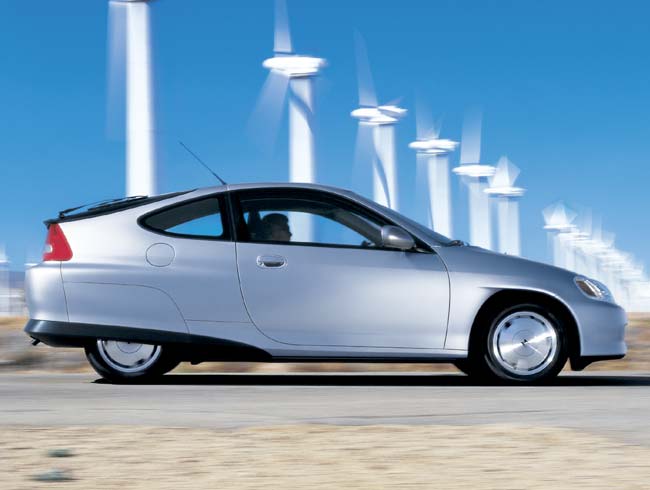
4. 2010 Honda Insight-not as good a mpg as the Prius, but much friendlier price
3. 2010 Toyota Prius- 50 mpg
2. 2010 Chevrolet Volt- "will be the first affordable, extended range electric vehicle on the market to have real practicality"
1. 2009 Ford Fusion Hybrid - combined mpg of 38 with aspects of a performance vehicle

While some of these cars are a genuine step in the right direction, there are cars being given the "green" label that are more of a sham than anything else. These are the Top Five Green Wannabe's according to Greenited:
5. Dodge Circuit concept- a "stolen" design with production issues
4. 2009 Lexus GS 450h- a pretty inefficient car, not worthy of the hybrid label with a high price tag
3. 2009 Chevrolet Silverado 1500 Hybrid- only eeks out a few more mpg than its non hybrid counterpart, a useless hybrid
2. 2009 Chevrolet Tahoe Hybrid- see useless hybrid above
1.  2009 Cadillac Escalade Hybrid-  see useless hybrid above and raise to extra useless.

These green cars aren't perfect. Although they cut back emissions, they are merely a triage until a feasible, maintainable, and environmentally sound energy solution is found. So do we buy these stopgap measures until the real deal solutions come out? I think it's a step in the right direction. Something that has to be changed first, though, is our perception about driving. Many consumers have trouble with hybrids and other green cars because they "lack performance" found in standard cars. Basically, there isn't as much "zoom," so these cars aren't as fun to drive. Therein lies our faulty viewpoint. Driving isn't meant necessarily to be fun, it's meant as a way to transport goods, people, etc. If it gets you from point A to B, it's a success. Stop worrying so much about which cars can go 0-60 in fractions of a second, worry more about how much carbon and other pollutants are being emitted from the tailpipe.

Works Cited:

Friday, May 16, 2008

Earn Some Green While Going Green


There are several envrionmental benefits that accompany using alternative engery. However, what some people fail to realize is that there are also numerous economic benefits that "going green" promotes.


In an article titled, "Everything's Gone Green" published in Business and Finance this issue is further explored. High fuel prices, crisis in the Middle East, and political insecurity have recently caused the United States economy to spiral out of control. As Americans across the country pull into gas stations to filll up, it is becoming increasingly obvious that gas prices are reaching record highs.


Investment banking groups are not letting this energy switch go unnoticed. Groups such as JP Morgan and Citigroup are establishing investing task forces in an effort to invest in alternative engery. These companies are seizing the chance to capitalize on the current "green" trends. Investment firms are jumping at the chance to get a piece of the financial pie as new energy sources such as wind-power turbines, hydro-electricity, and biofuels become more commonly used.


The CFO of Ecosecurities, Jack MacDonald commented on this occurance when he stated, ""With costs of energy going up dramatically, renewable energy is becoming more cost-effective than fossil fuel and is driving the development of renewable projects globally. Also, with climate change in the background, companies are increasingly focusing on alternative energy to reduce their carbon emissions footprint. The biggest investments being made are in sectors such as wind power, hydro projects, biomass, energy efficiency and the solar industry."


Wednesday, May 14, 2008

Making Light of a Heavy Subject


The Clean Air Energy: Nuclear Power


Despite some drawbacks when referring to the safety of disposal and maintenance of radioactive waste due to the long half-life of many byproducts, nuclear energy is one of the most promising technologies to help the human species reduce our carbon footprint.


According to the Nuclear Energy Institute, "nuclear plants are the lowest-cost producer of baseload electricity. The average production cost of 1.72 cents per kilowatt-hour includes the costs of operating and maintaining the plant, purchasing fuel and paying for the management of used fuel."


This graph clearly compares the production cost of several various forms of energy. Clearly, petroleum, which accounts for a high percentage of usage, has the highest production cost while the production cost of nuclear energy is much lower per kilowatt-hour.

Nuclear power plants aid compliance with the Clean Air Act of 1970, which sets standards to improve the nation's air quality. Because nuclear power plants generate heat from fission rather than from burning fuel, they produce no greenhouse gases or emissions associated with acid rain or urban smog.

Additionally, nuclear energy keeps American business growth competitive, as well as provides local job growth in places where plants are built.

While nuclear energy should not be considered as the only source of alternative energy, allowing the construction of new plants and increasing the productivity of old ones would serve the environment and the economy positively.


Thursday, May 8, 2008

It's time to pay attention:


Maybe it is time for America to step up and take action!!!

Wednesday, May 7, 2008

Solar Airplane Concepts

There has recently been an anouncement of the production of a portable solar charger for airplane avionics. Scientists and architects are looking into the possibility of airplanes being powered by solar energy. according to this renewable energy website I found, there are several different solar airplane concepts that are currently being considered and explored.

The Helios Prototype solar-electric flying wing was one of several remotely piloted aircraft, also known as uninhabited aerial vehicles or UAVs, that were developed as technology demonstrators under the now-concluded Environmental Research Aircraft and Sensor Technology (ERAST) project. Prior to its loss in an in-flight mishap in June 2003, the Helios Prototype set a world altitude record for propeller-driven aircraft of almost 97,000 feet.


Pathfinder was first developed for a now-cancelled classified government program in the early 1980’s to develop a high-altitude, long-endurance aircraft for surveillance purposes. Known as the HALSOL (for High-Altitude SOLar) aircraft, its eight electric motors — later reduced to six — were first powered by batteries.


The Centurion is a lightweight, solar-powered, remotely piloted flying wing aircraft that is demonstrating the technology of applying solar power for long-duration, high-altitude flight. It is considered to be a prototype technology demonstrator for a future fleet of solar-powered aircraft that could stay airborne for weeks or months on scientific sampling and imaging missions or while serving as telecommunications relay platforms. It also has a wingspan of 206 feet.


The “Hy-Bird” project plans to fly around the world with a 100% clean electric airplane powered only by renewable energies: solar energy and hydrogen. The goal is to design an airplane, which will use only renewable energies with no greenhouse gas emission.
Here is a link to see more of the solar airplane ideas and also videos of each:

Monday, May 5, 2008

Why I don't buy a hybrid...


A poll featured in Daily Fuel Economy Tip asked “What’s stopping you from buying a hybrid car?” Among the various responses were the following:


-49% of respondents stated that hybrid cars are too expensive
-29% of respondents stated that they were waiting for plug-in hybrid vehicles ( a vehicle combining the benefits of an electric car and a hybrid car)
-11% of respondents stated that they just are not interested in buying a hybrid vehicle
-9% of respondents stated that hybrid cars are too small
My response to "What's stopping you from buying a hybrid car?"... I think they are ugly. If we look at society today we see that society values materialistic as well as nice looking things. Take that coal commercial for example, viewers enjoyed the commercial because of its sex appeal, not because of their concern with using coal as a source of energy. People choose to drive Hummers because they believe they are what they drive. If you want to command a room and come off as powerful, than a Hummer is the way to go, not a hybrid. What can I say, Americans have good taste and expect to own nice things. I firmly believe that if car companies started to make fuel efficient cars that were more stylish and similar to the favorites we have now, people in general would be more willing to help the environment by buying one.