Monday, April 18, 2011

The Potential of Solar Power


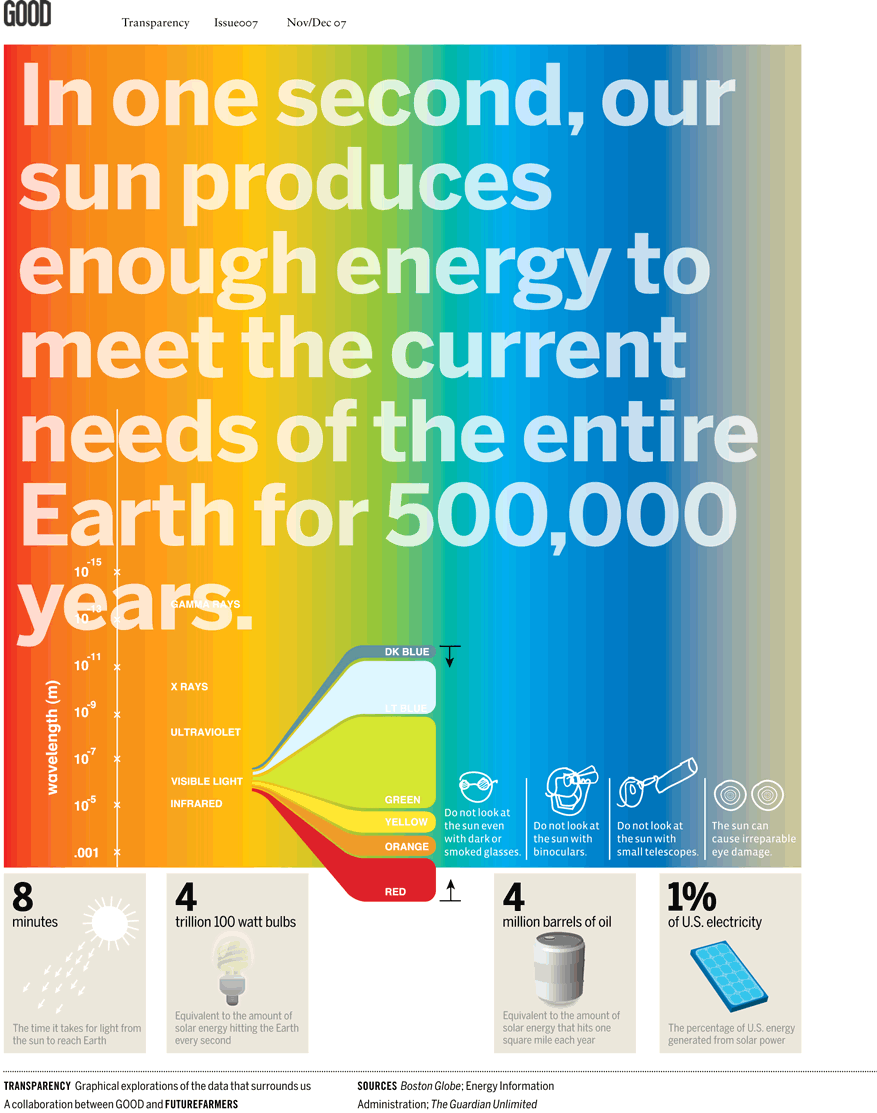
Here is an interesting infographic that I found about how much energy the sun produces. This demonstrates that if we could develop an extremely efficient way to harness the sun's energy, we would have many of our energy needs met. (http://solarenergyfactsblog.com/wp-content/uploads/2010/11/solar-energy-infographic.gif)

**I know that the photo is a little large to be viewed on the blog itself, but if you click on the photo it will take you to the site where the infographic can be viewed in full.**

Tuesday, April 12, 2011

California's New Alternative Energy Law

Recently there was a new energy mandate signed into law in California by the Governor Jerry Brown. This mandate is the most aggressive clean energy standard in the nation. “… Requires the state’s utilities to get 33 percent of their electricity from renewable sources like geothermal, wind and solar by 2020” (Hull). This is a high standards bill but the details are being questioned by some. For example there are many permits needed and so the projects could be delayed and this would increase prices. However the law also contains provisions that are supposed to protect consumers from what is happening with the rising fuel prices and requires the approval of renewable energy contracts (Hull). In the article there is several different renewable energy sources cited but the two expected to make up the vast majority of new contracts in the coming years is solar and wind power.

Solar power is a powerful, inexhaustible and clean source of energy. “Every hour the sun delivers as much energy to the Earth as all humanity uses in a year” (Environmental Defense Fund). With this in mind one could wonder why we don’t use that energy as our only source. However, it is more complex to harness the energy in a widespread and inexpensive way. Because solar power is dependent on the sun, if the sun does not shine there is no power. Since the sun doesn’t shine every day all day there needs to be back up electricity and therefore other sources of power still need to be used. Not only this, but solar power is expensive making it undesirable to most. In recent years the price has decreased making the power a more likely method and hence the prediction for it to become a more preferred method.

The second predicted method to become a major source of power in new contracts is wind power. Wind power is considered a type of solar energy because wind is the product of uneven hearting of the atmosphere by the sun. Today it is possible to drive through a wind farm where there are hundreds of huge wind turbines converting wind into energy. “The wind turns the blades, which spin a shaft, which connects to a generator and makes electricity” (US Department of Energy). Because it is wind it is a clean fuel source and so doesn’t pollute the air. The wind supply in the United States is abundant because wind cannot be used up, it is a renewable power. It is also one of the cheapest forms of renewable energy available today. Even though this is true the initial investment for a wind farm is higher than fossil-fueled generators making it more difficult for someone to invest in the wind energy. Most signs point to wind power plants as being successful but many are simply concerned about the noise of the turbines. Which is the worse consequence, noise or pollution?

With this all in mind California now has to consider all types of alternative energy, costs of them and how to reach this 33 percent mark. Many are worried of costs and delays because of permits but it seems as if the CPUC has it under control. “We’ll make sure that ratepayers are protected” (Florio). If this law is enforced California will be an example for the nation. Some of the benefits also include economic ones such as increasing the number of jobs. The solar plant intended to be built is expected to create 350 jobs. Not only is this good for the environment but it would also help to boost the economy. The law has it’s downsides but there is a lot to factor into a standard such as this. Either way the idea of using more alternative energy is a step in the right direction. Whether it is upheld or goes as planned will be the real test of a law such as this.


http://www.mercurynews.com/business/ci_17828401?source=most_emailed&nclick_check=1

http://www.edf.org/page.cfm?tagID=23052&s_src=ggad&gclid=CLzp7L2gmKgCFYjsKgodi2XuDg

http://www1.eere.energy.gov/windandhydro/wind_ad.html

Monday, April 11, 2011

Chemistry Joke


Completly random I know but I was on stumble-upon and came across this. :) Enjoy!

Monday, April 4, 2011

Cars: “We Shouldn't Become Vegetarians, Yet.”

Gas prices are rising and due to the conflicts in the oil-rich regions of the world, they don’t show any sign of coming back down. In response we humans began to do what we always do when our resources begin to look scarce, improvise and invent. So we begin to devise new ways for automotives to use less of our precious fuel and begin to switch to cleaner alternative fuel. Thus the idea of ethanol is born and with it we hope to find the answers of our fuel crisis. However, despite the growing popularity of ethanol, in this day and age it is most definitely not the answers to our problems, in fact it might even create more issues then solve.

In order to understand why this otherwise ideal fuel alternative is not the best for this time and age, one must understand what ethanol is. Ethanol is an alcohol formed from the anaerobic fermenting of either a type of sugar or a grain. Ethanol is found mostly in alcohol beverages such as beer. The two most common sources of ethanol as of now are sugar beets and corn. While other sources could be used, these two plants show the highest potential for ethanol production. Its chemical composition is very similar to that of petrol or the gas we use to power our vehicles. It has a good amount of oxygen in its composition which allows it to burn more cleanly then petrol. Because of all these things ethanol seems like the ideal choice of an alternative fuel for gasoline but there are many things that point to it not being the best idea as of now.

Mainly there are two reasons why focusing more on ethanol as an alternative fuel is a bad choice. The first reason is the amount of fuel it actually takes to produce the produce and then convert it into ethanol. This whole process, while it seems like its saving energy at the end, really is not. This process actually causes net loss in energy and while ethanol is seen as a great alternative to gasoline, it uses what it replaces to be created. The second major issue is how we would be able to grow enough corn and regulate it so that the fields don’t become barren from overuse. Corn fields take multiple years to get the nutrients back to that it can produce corn again. Also currently there are issues with the abrupt rise in food prices. If we were to start dedicating tons of acres of fields of corn to ethanol production, the prices would go even higher. With the economy as it is and the rising of gas prices, the additional rise of food will be more devastating. And it is for these reasons, though ethanol was a good idea, it is not suited for this time and circumstances.

http://auto.howstuffworks.com/fuel-efficiency/alternative-fuels/ethanol-facts1.htm
http://www.aboutmyplanet.com/alternative-energy/ethanol-fuel/

Sunday, April 3, 2011

Hydrogen Fuel

As I began to research alternative energy, hydrogen fuel is one source that caught my eye since I don't know very much about how it works and how it is used, only that people are trying to utilize it as a fuel source in cars. I was curious to find out how hydrogen fuel works. Hydrogen fuel is typically produced through fuel cells, which has an electrolyte in between an anode and cathode. Hydrogen molecules enter at the anode, and the protons pass through the electrolyte while the electrons are directed through an external circuit which generates an electrical current. Oxygen molecules enter at the cathode, where they react with the protons and electrons of hydrogen. The products of the reaction are water and heat.

Like any alternative fuel, it has its advantages and disadvantages, specifically when it comes to its use in cars. An advantage is that it produces no pollutants; its only byproduct is water. It can be produced domestically, reducing dependence on foreign oil. However, it has some obstacles it must overcome before it can be widely used. It poses a risk to drivers when they’re refueling their cars, since there is a chance that the hydrogen can combust with oxygen which causes the pump to burst into flames. Secondly, hydrogen does not exist naturally, so it takes energy to produce and it is expensive to produce. Currently, it's only manufactured at a few sites. Because of the manufacturing costs, fuel cell cars are not affordable for consumers. Thirdly, compared to the same volume of gasoline, hydrogen has much less energy, so it is difficult to create cars that with effective on board storage that will get far in between fill ups.

It is also interesting to note some recent developments that have been made regarding hydrogen fuel. Cella Energy has developed electrospraying, in which hydrogen is absorbed in microscopic sponges. What this technological jargon means for consumers is that refueling can now be safer. The sponges can be exposed to the air, so there is less concern about hydrogen combusting when drivers stop to refuel their cars. Also, another advance in hydrogen storage was made at Los Alamos National Laboratory which addresses the limited amount of fuel that can be stored in a car’s fuel tank. They discovered that ammonia borane has a high hydrogen storage capacity. This new storage system would allow hydrogen powered cars to pass the US Department of Energy’s benchmark requiring that the cars can be driven at least 300 miles on a single tank. Also contributing to the efficiency is that the ammonia borane can be regenerated into a usable form within the fuel tank. This crucial factor increases the practicality of hydrogen cars.

Through this research I have discovered that although hydrogen power has made leaps and bounds, there are still many steps that need to be taken to improve its development.

This post is based on the following sources:

http://www.fueleconomy.gov/feg/hydrogen.shtml

http://www.alternative-energy-news.info/technology/hydrogen-fuel/

http://reviews.cnet.com/8301-13746_7-20049733-48.html

http://www.sciencedaily.com/releases/2011/03/110321093701.htm

Monday, March 28, 2011

Hydropower: The Hoover Dam

A few years ago, my family took a week-long trip to Nevada and Arizona. While driving from Nevada to Arizona, we stopped at the Hoover Dam for a few minutes and took pictures and marveled at the sheer size of the dam. However, while I was there, I never realized how much clean, renewable energy that the the Hoover Dam generates for our country.

The Hoover Dam is a great source of clean and renewable hydropower. The Hoover Dam began construction in 1931 and was completed in 1936. At the time, it generated more electric power than anywhere else in the world and was the largest concrete structure. Most of the energy produced by the Hoover Dam goes to one of four places, Met Water District of Southern California, the state of Nevada, the state of Arizona, or Los Angeles, California.

The Hoover Dam has many important functions for the surrounding areas, as well as the environment. The dam releases no greenhouse gases, except for the gases that were released during its construction. It also manages the Colorado River, prevents floods, and provides farmers with a regular water supply.

The Hoover Dam generates electricity using hydropower. Hydropower is the power generated by moving water. Dams are often built on a large river, so the water falls down from the top of the dam. At the bottom of the dam, the water rotates a large turbine, which results in energy production in a generator. Approximately 20% of the world's power is generated by hydropower.

There are two major factors that determine how much power will be generated by the dam: the amount of water and the height that it falls. Because Hoover Dam is so tall (approximately 726 feet) and is situated on a large river (the Colorado River) it provides a relatively large amount of energy that could be used to power all of Los Angeles, California.

The major proponents of hydropower argue that it is a great source of energy because it is free and readily found in nature. It also does not use up water in its production of energy, rather it just moves it. The people that argue against hydropower note that changing the way that the water flows greatly disrupts fish migration and disrupts the natural system. For example, because of building the Hoover Dam about four species of fish are considered endangered as a result.


http://www.enviro-news.com/article/hoover_dam_nevada.html
http://www.benefits-of-recycling.com/alternativeenergywater.html

For more information on hydropower:
http://www.eia.doe.gov/kids/energy.cfm?page=hydropower_home-basics-k.cfm
http://www.lenntech.com/water-energy-faq.htm
Thursday, March 17, 2011

Thinking outside the box: wacky but effective alternative fuel sources

So I’m researching alternative fuel sources online, and I come across this one website titled “Five of the World’s Weirdest Alternative Fuel Sources”. Of course, being the naively curious college freshman that I am, I click on the link, thinking it’s going to be some dumb practical joke on someone’s Twitter or personal blog. Well it turns out the site was a blog, but the information it totally legitimate! The blog is maintained by a company called Ecoble, which was created by Australian software engineer Brett Stark. Ecoble aims to raise online awareness of environmental problems and to propose solutions for these problems. Anyway, Stark’s threads on his Ecoble blog talk about strange alternative fuel sources and how they are actually completely viable options that could potentially be used in the very near future.
One of the proposed alternative fuel sources, believe it or not, is the use of dirty diapers! Basically, it has been proposed by one company that with the right machinery, 30,000 tons of dirty diapers can be annually transformed into over 10,000 tons of synthetic diesel fuel, and at a cost of just 50 cents per liter. Of course, diapers are not the only landfill material being thought of as a possible source for alternative fuel, but because of their constant output and mass quantities barraging landfills worldwide, diapers are a great item to start with. The supply, in theory, would be endless, and the transformation process these diapers go through into becoming synthetic fuels would be done in a closed system, therefore no harmful emissions will pollute the atmosphere!
Another alternative fuel source listed by Stark is confiscated alcoholic beverages. Every year, about 200,000 gallons of smuggled alcohol is caught by authorities before it can illegally make its way into Sweden. However, instead of throwing all of this alcohol away, the authorities have come up with a way to use this alcohol as an alternative fuel source. Through the mixture of certain alcoholic cocktails, buses and trains are powered with the resulting fuel source. As we discussed in class, yet another more popular method of attaining fuel sources comes from the siphoning of methane gas from garbage dumps. In fact, recently researches have even gone as far as proposing that garbage dumps be kept under more of a closed system so as to produce as much methane gas as possible so more fuel can be harvested. If you really think about it, there are so many everyday objects that can be used to quench our seemingly-insatiable thirst to find the best alternative fuel source out there…sometimes we just have to think outside the box a little bit.
http://ecoble.com/2007/12/02/five-of-the-worlds-weirdest-alternative-fuel-sources/
http://www.imaginelifestyles.com/luxuryliving/2010/10/top-8-strange-alternative-fuels
http://www.fromtheworkbench.com/top-5-strange-alternative-energy-sources/

Tuesday, March 15, 2011

Nuclear Energy as an Alternative Energy Source

There are many proposed solutions to the issue of pollution, all sorts of types of alternate energy but there is a catch to all of them. Wind power is not consistent, solar power is inconsistent and expensive to build the necessary resources, geothermic can be a pollutant if not done right and is not long term, hydroelectric is expensive and needs a powerful flow of water, biofuels require a lot of natural resources and then hydrogen takes more to produce than it is currently worth. Then we come to the question of why not use nuclear energy? Nuclear energy has many advantages with two major disadvantages being the waste and health issues that come from producing the powerful energy.

With the current nuclear issues in Japan there is a focus on the advantages and disadvantages of nuclear power plants. Nuclear energy is created through the fission or fusion of atoms and the reaction developed from this action is used as energy. Nuclear energy is one of the most powerful and so not as many plants would be necessary for the desired amount of energy needed. Environmentally this energy is clean. After a plant closes, however, there still is the concern for waste. For years after a nuclear plant is shut down there needs to be guards surrounding the waste so none gets out. The waste cannot be transported to one location without fears of it being released on the way there, or the people in that location protesting against nuclear waste being stored there.

For some time now a Germany-wide project sponsored by the Federal Ministry of Economics and Technology (BMWi) has been developing to find a geological repository for the waste. Recently there has been a breakthrough with using clay stone. This natural clay holds a great potential for hopes of permanently disposing of nuclear waste. Opalinus clay found in Switzerland was made into cylinders and in these was pore water with radioactive neptunium or plutonium. Chemists found, “The batch experiments show that radioactive plutonium in the oxidation state IV is nearly totally absorbed on Opalinus Clay, leaving almost no plutonium in the aqueous solution. In the case of neptunium (V), the corresponding ratio is 60:40. However, if neptunium is reduced to neptunium (IV) by iron minerals present in the clay, a near 100 percent sorption of neptunium on the clay is observed.” (Science Daily)

What this means is the clay is potentially a source of containment for the nuclear waste getting rid of that specific issue. With getting rid of the issue of waste leaves only the issue of a meltdown. Meltdowns leading to high or long term radiation can lead to certain cancers and respiratory issues. Health issues are an issue especially concerning the potential meltdown of a plant now seen in Japan and that can be seen in history as well. The area around Chernobyl, the site of a major 1986 nuclear meltdown, has just started being resettled in the last year. With this kind of consequence to a meltdown means major expenses. Another issue is the health dangers. Depending on the level of radiation released effects could be cancer and other dangerous issues. With these issues there is a controversy on using nuclear power. It is the most effective but can have some of the most dangerous long term consequences. So do we continue to use it or abandon the idea and focus on other means of energy?


Sources:

http://www.sciencedaily.com/releases/2011/03/110308075849.htm

http://typesofalternativeenergy.com/

http://www.world-nuclear.org/info/chernobyl/inf07.html

Tuesday, March 8, 2011

I recently read an article in the Washington Post about natural gas drilling in Wyoming, and how the industry is becoming more profitable in the region. And now little dinky Cheyenne is seeing smog levels usually only seen in major urban centers like LA. When I think Cheyenne, I think cold, so I personally was surprised that they were having this problem. It’s the sunnier, urban areas that you usually associate with smog and haze.
People in the area have been complaining about bloody noses, watery eyes, and shortness of breath, which has been attributed to the high levels of ozone in the atmosphere over Cheyenne, which is higher than even the worse LA days. The drilling of the oil releases nitrogen oxide and VOCs. The article explained that the release of these chemicals, combined with the snow on the ground, sunshine, and temperature inversion are creating the high levels of tropospheric ozone, so it is only a problem in the winter.
The article cited that two days last week, ozone levels in the region rose above the highest levels ever recorded in the most populous U.S. cities (Gruver). On the bright side, Wyoming has an unemployment rate of 6.4%, one of the lowest in the nation (Gruver). But are the economic gains worth the trade-off in terms of human health. I say no.
Last Wednesday the ozone levels reached 124 ppb. The EPA’s limit for healthy ozone levels is only 75 ppb. The worse day in LA last year was 114 ppb (Gruver). I think that a city exceeding the ozone limit by 49 ppb, especially in a city as small as Cheyenne is definitely a problem. The gas officials claim that are “working hard to curb smog by reducing truck traffic and switching to drilling rigs with pollution control equipment” (Gruver). But clearly they are not working fast enough.
People should be allowed to go outside freely and not have to worry about their health or getting a nosebleed. Wyoming is generally an outdoorsy place, so the warnings to stay inside must be hard to take.

http://www.washingtonpost.com/wp-dyn/content/article/2011/03/08/AR2011030802905.html

Sunday, March 6, 2011

A Few Problems with Wind Farms

Wind farms look like a very promising source for energy. However, they are not without their problems. Wind turbines stir the air bringing down the higher-level air and bringing up the lower-level air and mixing them together. This creates a cooling effect during the day and a warming effect during the night. In some regions, where winds are stronger at night and the warming effect dominates, some frost protection is provided and the growing season for crops may be locally and shortly extended (3). The warm air coming down is not always beneficial, however. The warm winds being brought closer to the surface can cause the evaporation of the moisture in the soil and cause problems for crops. This may lead to increased costs for irrigation (2). Also, in coastal areas, where the day winds are stronger and the cooling effect dominates, problems can occur (3).

Crops are not the only things affected by the stirring of the air caused by the turbines. Weather radars are also affected and the results can be dangerous. During storms, the turbulence caused by the wind turbines appears on the radar in the same way a tornado would. This is picked up by the computerized systems and warnings can be sent out when nothing is there. The weather forecasters often catch these mistakes and cancel the alerts. However, when forecasters are the ones making quick decisions, though frequently erring on the side of caution, may easily spot the signal and disregard it as a wind turbine when it may actually be a sever weather pattern (1).

One researcher suggests that replacing the routers that the blades spin around with more efficient and updated ones will significantly help the turbulence given off by the turbines (2). Also, some researchers have pointed out that the problems are increased when the farms are within 11 miles of the radar stations, which can be solved by working with the farm owners to move into locations that will have less effect on the radars. However, since both wind farmers and meteorologists both desire the same locations due to high elevations and flat clear lands being optimal for both purposes, this arrangement is a frequent problem (1).

All information above was found in the following articles:

1. http://www.thestar.com/sciencetech/article/686890

2. http://www.sciencedaily.com/videos/2005/1012-wind_farms_impacting_weather.htm

3. http://www.sciencedaily.com/releases/2010/10/101005121726.htm