Wednesday, May 7, 2008

Solar Airplane Concepts

There has recently been an anouncement of the production of a portable solar charger for airplane avionics. Scientists and architects are looking into the possibility of airplanes being powered by solar energy. according to this renewable energy website I found, there are several different solar airplane concepts that are currently being considered and explored.

The Helios Prototype solar-electric flying wing was one of several remotely piloted aircraft, also known as uninhabited aerial vehicles or UAVs, that were developed as technology demonstrators under the now-concluded Environmental Research Aircraft and Sensor Technology (ERAST) project. Prior to its loss in an in-flight mishap in June 2003, the Helios Prototype set a world altitude record for propeller-driven aircraft of almost 97,000 feet.


Pathfinder was first developed for a now-cancelled classified government program in the early 1980’s to develop a high-altitude, long-endurance aircraft for surveillance purposes. Known as the HALSOL (for High-Altitude SOLar) aircraft, its eight electric motors — later reduced to six — were first powered by batteries.


The Centurion is a lightweight, solar-powered, remotely piloted flying wing aircraft that is demonstrating the technology of applying solar power for long-duration, high-altitude flight. It is considered to be a prototype technology demonstrator for a future fleet of solar-powered aircraft that could stay airborne for weeks or months on scientific sampling and imaging missions or while serving as telecommunications relay platforms. It also has a wingspan of 206 feet.


The “Hy-Bird” project plans to fly around the world with a 100% clean electric airplane powered only by renewable energies: solar energy and hydrogen. The goal is to design an airplane, which will use only renewable energies with no greenhouse gas emission.
Here is a link to see more of the solar airplane ideas and also videos of each:

Monday, May 5, 2008

Why I don't buy a hybrid...


A poll featured in Daily Fuel Economy Tip asked “What’s stopping you from buying a hybrid car?” Among the various responses were the following:


-49% of respondents stated that hybrid cars are too expensive
-29% of respondents stated that they were waiting for plug-in hybrid vehicles ( a vehicle combining the benefits of an electric car and a hybrid car)
-11% of respondents stated that they just are not interested in buying a hybrid vehicle
-9% of respondents stated that hybrid cars are too small
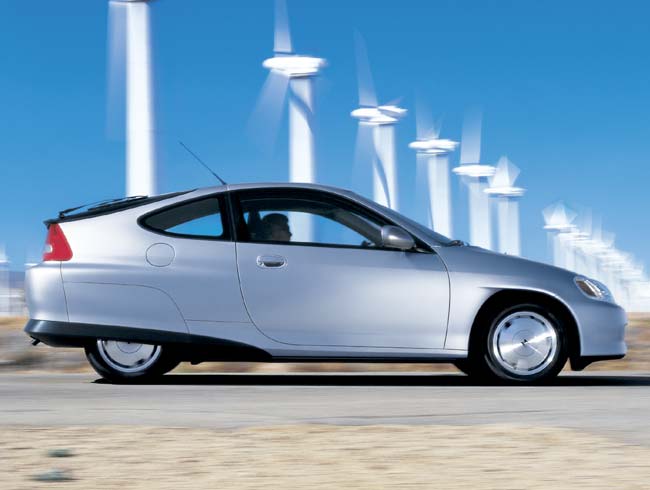
My response to "What's stopping you from buying a hybrid car?"... I think they are ugly. If we look at society today we see that society values materialistic as well as nice looking things. Take that coal commercial for example, viewers enjoyed the commercial because of its sex appeal, not because of their concern with using coal as a source of energy. People choose to drive Hummers because they believe they are what they drive. If you want to command a room and come off as powerful, than a Hummer is the way to go, not a hybrid. What can I say, Americans have good taste and expect to own nice things. I firmly believe that if car companies started to make fuel efficient cars that were more stylish and similar to the favorites we have now, people in general would be more willing to help the environment by buying one.

Is ethanol production increasing food prices?

There has been much speculation about this very question for quite some time. Recently, a group of 23 GOP Senators have asked the EPA to roll back requirements on an energy bill that stipulates the increased produciton of biofuel/ethanol five fold by 2022. You can read the article here.

But, is that the real source of corn prices going up? The answer is complicated. Though ethanol has increased corn prices marginally, the impact is very little.

There are many different factors that go into the production of products that contain corn. The most widely used example of this is the cereal Corn Flakes. According to Ephraim Liebtag in his article "Corn prices near record high, but what about food costs?" states that in a box of Corn Flakes, the amount of corn in price is equal to about 3.3 cents after taking into consideration the price per bushel and corn used for the flakes. The rest is transportation, packaging, advertising etc. The then increase in corn of 49 cents a bushel, only pushes the cost up 1.6 cents. A negligible difference.

In addition to that, the USDA had predicted correctly for last year that 2007 would yield the largest corn crop ever seen. A 10.6% increase to 13.1 billion bushels from the previous record in 2004 of 11.8 billion bushels. More corn in the supply would dictate that even if demand increases, prices would stay relatively constant.

I am going to say that the reason food prices are increasing is because it is more expensive to bring the food to us. Oil is used to transport the food, make the packing and sometimes even cool the food in the fridge (We do, after all, use electricity). Soaring oil prices are the culprit for our woes. Ethanol, though not a permanent energy solution, is a nice first step. It has seen no real impact on the edible corn grown for humans.

Tuesday, April 29, 2008

Hydrogen Cars

We have all come to know that cars powered by combustion technology is getting too expensive with adverse environmental effects. There are other alternatives such as electric hybrids, corn oil and so forth. Hydrogen powered cars are another one.


Liquid hydrogen is combined with oxygen to generate electricity. The electricity is used to power the engine of the car. The energy produced by this reaction powers the car. The byproduct of the combustion is water, so it does not harm the environment at all. President Bush has allocated $2 billion dollars to research hydrogen technology. This is simply another way to lessen our dependence on oil in general no matter its origin.

There are currently many drawbacks to this idea. For one, the technology is still very expensive. Honda introduced the CFX, a car that gets 45% efficiency and costs $3 million. Regular cars that have hydrogen technology are generally more expensive because they require metals like platinum. A simple 134 hp fuel cell would be $3000. There also many concerns that productions costs for hydrogen could be vastly expensive.

Lastly, a concern is that hydrogen is very flammable. Tanks would have to be reinforced very much in order to avoid a disaster should a collision occur.

Sources: Hydrogen Car Difficulties
Hydrogen Car Vehicles
Hydrogen Powered Vehicles

Monday, April 28, 2008

Hydroelectric Generation


Did you know that Hydroelectric generation is the predominant form of electric generation in Canada? It is, nearly two-thirds of Canada's power is generated each year by this process. Hydropower is both inexpensive and nonpolluting.

How it works: So just how do we get electricity from water?

"Actually, hydroelectric and coal-fired power plants produce electricity in a similar way. In both cases a power source is used to turn a propeller-like piece called a turbine, which then turns a metal shaft in an electric generator, which is the motor that produces electricity. A coal-fired power plant uses steam to turn the turbine blades; whereas a hydroelectric plant uses falling water to turn the turbine. The results are the same" (USGS).
"The theory is to build a dam on a large river that has a large drop in elevation. The dam stores lots of water behind it in the reservoir. Near the bottom of the dam wall there is the water intake. Gravity causes it to fall through the penstock inside the dam. At the end of the penstock there is a turbine propeller, which is turned by the moving water. The shaft from the turbine goes up into the generator, which produces the power. Power lines are connected to the generator that carry electricity to your home and mine. The water continues past the propeller through the tailrace into the river past the dam. By the way, it is not a good idea to be playing in the water right below a dam when water is released!" (USGS).
"A hydraulic turbine converts the energy of flowing water into mechanical energy. A hydroelectric generator converts this mechanical energy into electricity. The operation of a generator is based on the principles discovered by Faraday. He found that when a magnet is moved past a conductor, it causes electricity to flow. In a large generator, electromagnets are made by circulating direct current through loops of wire wound around stacks of magnetic steel laminations. These are called field poles, and are mounted on the perimeter of the rotor. The rotor is attached to the turbine shaft, and rotates at a fixed speed. When the rotor turns, it causes the field poles (the electromagnets) to move past the conductors mounted in the stator. This, in turn, causes electricity to flow and a voltage to develop at the generator output terminals." (USGS).
Pros:
- "sustainable and nonpolluting power source that can help decrease our dependence on fossil fuels and reduce the threat of global warming" (USC).
-cost effective
Cons:
By blocking rivers with massive dams, we have created a number of serious environmental and social problems:
-habitat destruction
-prevention of fish passage
-decrease in Salmon population
-displacement of local communities
-dam failures
Personally I think Canada has the right idea and hydropower is the way to go. I think many people would like it because it is cost effective. Look at how high oil prices are now, why not choose something that is inexpensive and will save us money in the future. I think the pros of hydropower outweigh the cons. "The major advantage of hydroelectric power is reduction of CO2 or elimination of same. In addition, no nuclear waste is generated. Lastly, hydroelectric power gives some considerable immunity to fuel cost increases" (The Local).
Enough about what I believe, I am curious to hear what you think. Just remember, "In our modern world, hydroelectric has a great deal to offer. It's efficient and environmentally sensitive. It is sustainable in rural and urban settings. It emits no greenhouse gases, wastes or air pollution. It is renewable, efficient, flexible, uses existing technology, is low maintenance and decreases pollutants from fossil fuel. These advantages need to be weighed against disadvantages, including high initial cost, impact on habitats, potential disturbance of water quality and forced migration of local populations." So weigh the pros and cons for yourself and let me know your reactions.
Work Cited:

Our role in the environment

I came across this image while searching online for new topics on alternative energy and thought that it was a creative way of displaying what we, as individuals, can do to protect our environment. Many people feel that any actions they take to preserve our environment, will have no real or lasting effect. However, any small step towards living a more sustainable life, will have an impact in the long run. I feel that it is important to be educated with the knowledge of what effects our actions have on the environment and how to make the best use of our resources. This does not mean that we must live like the Amish, with no current technology, but that we should maintain a standard of living for all, where our economy can flourish without permanently damaging the environment and the resources it provides. Alternative energy is one way to do this. Since fossil fuels are non-renewable, it is necessary for our world to begin turning towards other options. It might seem unrealistic to most people at the moment, but it is definite that in the future, we will be forced to become a more "green" economy. To each individual, I believe that this means not to "splurge" on things that are not necessary and to conserve as much as possible. I understand that there are still going to be those people that don't believe in global warming and will continue to consume much more energy than is necessary and have no desire to help the environment, but the trend needs to start somewhere. This is the idea that the image depicts and if everyone does their part in helping preserve the environment, then it will have a lasting effect on future generations.


Wednesday, April 23, 2008

Carbon Emission – Better energy uses to offset your carbon foot print

Carbon Dioxide seems to be the bad guy now days when we look to environmental hazards. No matter where you turn, commercials, advertisements, and articles tell you to curb your carbon dioxide emissions. Every time I hear, read or see one of the warnings, I wonder how many tons of carbon I really emit as an individual. Believe it or no, it only takes seconds to figure out.

There are many means of determining your carbon dioxide emissions. Most commonly, scientists look to the cars you own, the house you heat and cool, and the trips you fly to each year. Logging on to the United States Environmental Protection Agency’s website on climate change, you can fill out an entire form to calculate your personal emissions, and then walk through the steps to reduce this.

1. CARS: The US EPA notes that the average American vehicle drives 231 miles per week. Because we live in Chicago, our cars emit even more CO2 from simply waiting in traffic.
Solution: Take a bus, ride a train, or carpool with friends! By finding a means of transportation that is shared by many, each individual can cut their personal CO2 emissions.
It would be important to note that the average car emits 12,100 pounds of CO2 emissions a year, so any reduction to this would be wonderful. Simply driving 131 miles a week would reduce your vehicle CO2 emissions by nearly 50%

2. WASTE: A household of 2 people creates about 2,020 pounds of CO2 a year simply though their waste… talk about disgusting! But did you know recycling can fix this?
Recycle Newspapers = -184 pounds of CO2/year
Recycle Glass = -24 pounds CO2/year
Recycle Plastic = -47 pounds of CO2/year
Recycle aluminum = -166 pounds of CO2/year

In only two steps, personal carbon dioxide emissions can be curb drastically. If you are interested in finding out your personal emissions, visit www.epa.gov and click on the CO2 emissions calculator under climate change. It’s fascinating to see the difference by driving a few less miles or reusing a bit more paper.

Happy Recycling!

Monday, April 21, 2008

Carbon Sequestration: Could it really work?

If you're left wondering about an answer to the question in the title, the answer is yes. They've been doing it Europe, Norway specifically. Currently, Norway's Sleipner West is the only major plant in the world to capture carbon. Before I proceed, I shall provide a brief rundown of how it works.

First, coal, oil or natural gas are burned like regular to produce electricity. Then the emissions are captured and sent down pipelines underground. The carbon dioxide is pumped into already hollowed out formations in the Earth. This can come from emptied former deposits of oil, or natural aquifers. The carbon can also help with the obtainment of oil. The carbon builds up in the reserve and pushes the liquid petroleum to a more confined space, allowing for remnants to be drilled out by pumps. This is it basically. Here are a few picture illustrations.


The Norwegian plants captures about 2,800 tons of CO2 daily. The system has been so effective that is won an award for being especially efficient in 2000 and has been in operation since 1996. There are a few concerns with this method though. It is very expensive and slightly risky. Although Europe has a 250 meter thick deposit for storage and can roughly hold 600 billion tons of CO2 (more than enough to save Europe for 600 years of 0 carbon emissions), the carbon won't stay down there forever. The plant's manager Tore A Torp says that is is very likely to be stored for at least several hundreds of years, even 5-10,000 more into a new ice age. By that point, he says, the carbon age will be over. He also notes that the seepage would not be more than regular CO2 leakage from the Earth. The price for running this particular plant has only risen 50-80 cents. This pales in comparison to the 1 million (then) Norwegian dollars it would be taxed for regular carbon expulsion into the air.

Canada recently unveiled a similar initiative, with their Prime Minister allocating $155 million to R&D. Alberta, Canada has many natural underground deposits that would be useful in this. The R&D does not threaten regular industry but actually encourages it. It allows for the companies to continue doing what they do with no environmental impact and harnesses left over oil. The same concerns loom here as well. Prices are predicted to go up by 10-20 cents for the consumer.

Sources: Take your carbon and stuff it
Norwegian Energy

Gas and oil prices hit high...


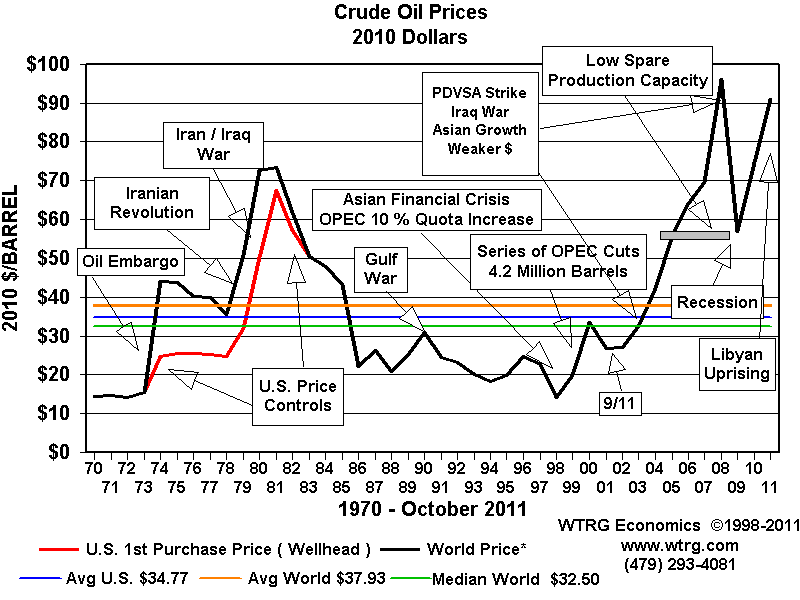
As a result of an attack on a Japanese oil tanker in the Middle East, crude oil prices set a new record today, spiking above $117.40 a barrel. "The tanker, the 150,053-ton Takayama, was hit by an unspecified projectile during the attack early Monday morning" (Fackler)

This news ultimately benefits investement holders as they are making a profit off of this sudden, yet gradual spike. On the other hand, this rise in crude oil prices proves to be bad news for the average consumer. "Retail gasoline prices hit another milestone today, jumping to an average $3.50 a gallon at filling stations across the country" (Associated Press).


With retail gas prices constantly increasing, it is important to find and enforce new forms of alternative energy. Alternative energy, in my opinion, would most likely be cheaper and more affordable than gasoline. If gasoline prices continue to rise dramatically, consumers are going to look to other sources of fueling. With this being the case, why not take a turn towards a healthier environment and further investigate forms of alternative energy. Did you know that "Gas prices at the pump jumped more than a nickel over the weekend nationwide, and are up 23 percent from a year earlier," at this rate who knows how high they will be come summertime (Associated Press). It is important to recognize this problem and know that we have a way of working through said problem. Alternative energy allows us to use our everday resources, therefore it is cheaper than having to pay for crude oil.
I found an article that I believe to be very interesting, as it further discuses the idea of 'Crude Oil vs. Alternative Energy':


Sources:
http://www.iht.com/articles/2008/04/21/asia/22tanker.php